Liguria (2) Camogli – one of the most charming fishing villages

IMG_4626
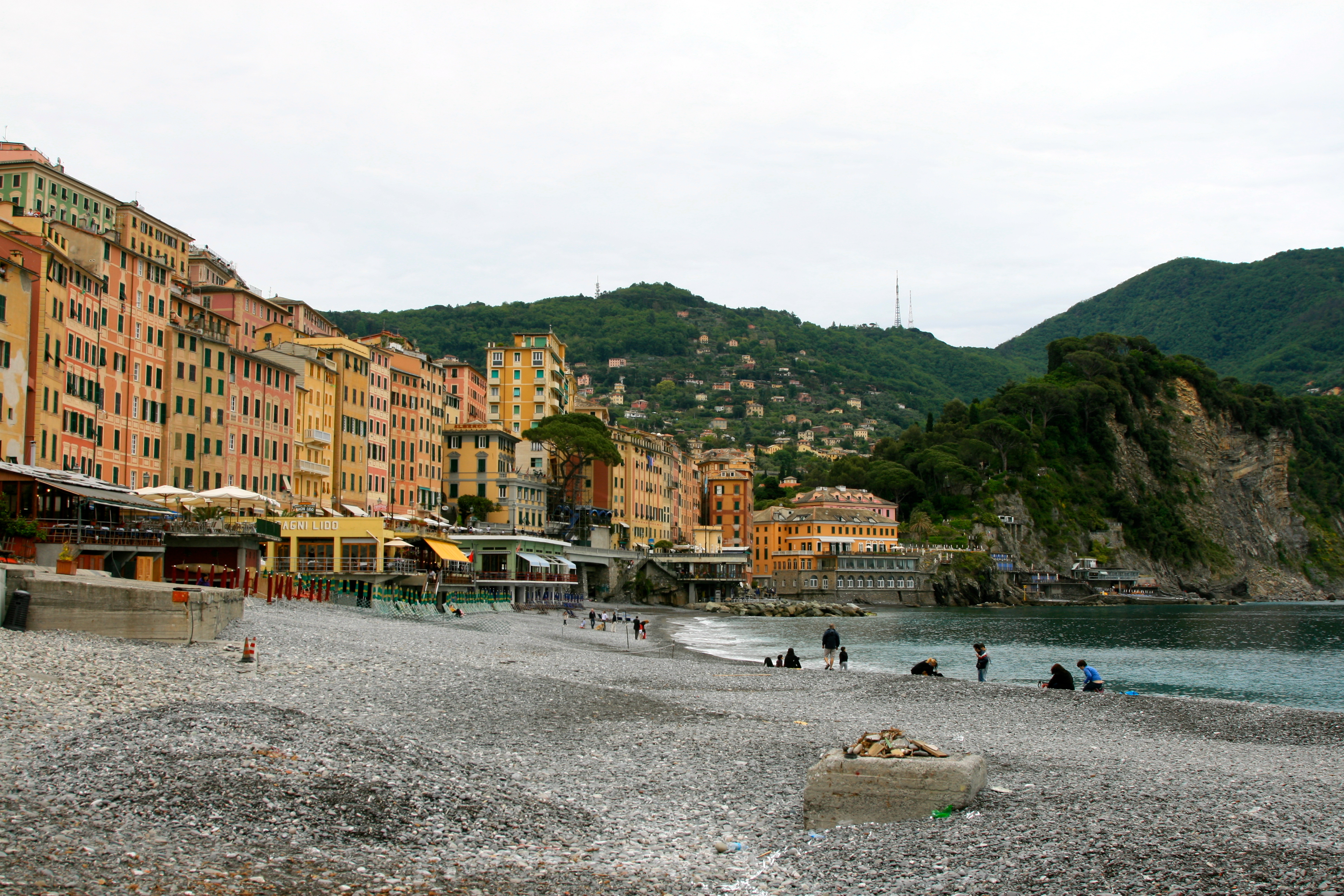
The view of Camogli – a charming fishing village

The first time we visited Camogli, we missed this fishing village, it is so hidden. The GPS in my car, normally reliable, took us to a hill whereby we could observe a superb view of Camogli and the Ligurian coast but couldn’t spot the way to get there.

After some time driving around we finally discovered that we needed to take a narrow street down towards the village centre. What we then discovered was amazing. Parking may be difficult depending on the time of year you visit but don’t be discouraged. It is really worth your time.

Camogli (Camuggi in Genoese dialect) is a small Italian fishing village and tourist resort located on the west side of the peninsula of Portofino, on the Golfo Paradiso at the Riviera di Levante, south from Genova. The name means “house of wives” ( casa delle Mogli ).

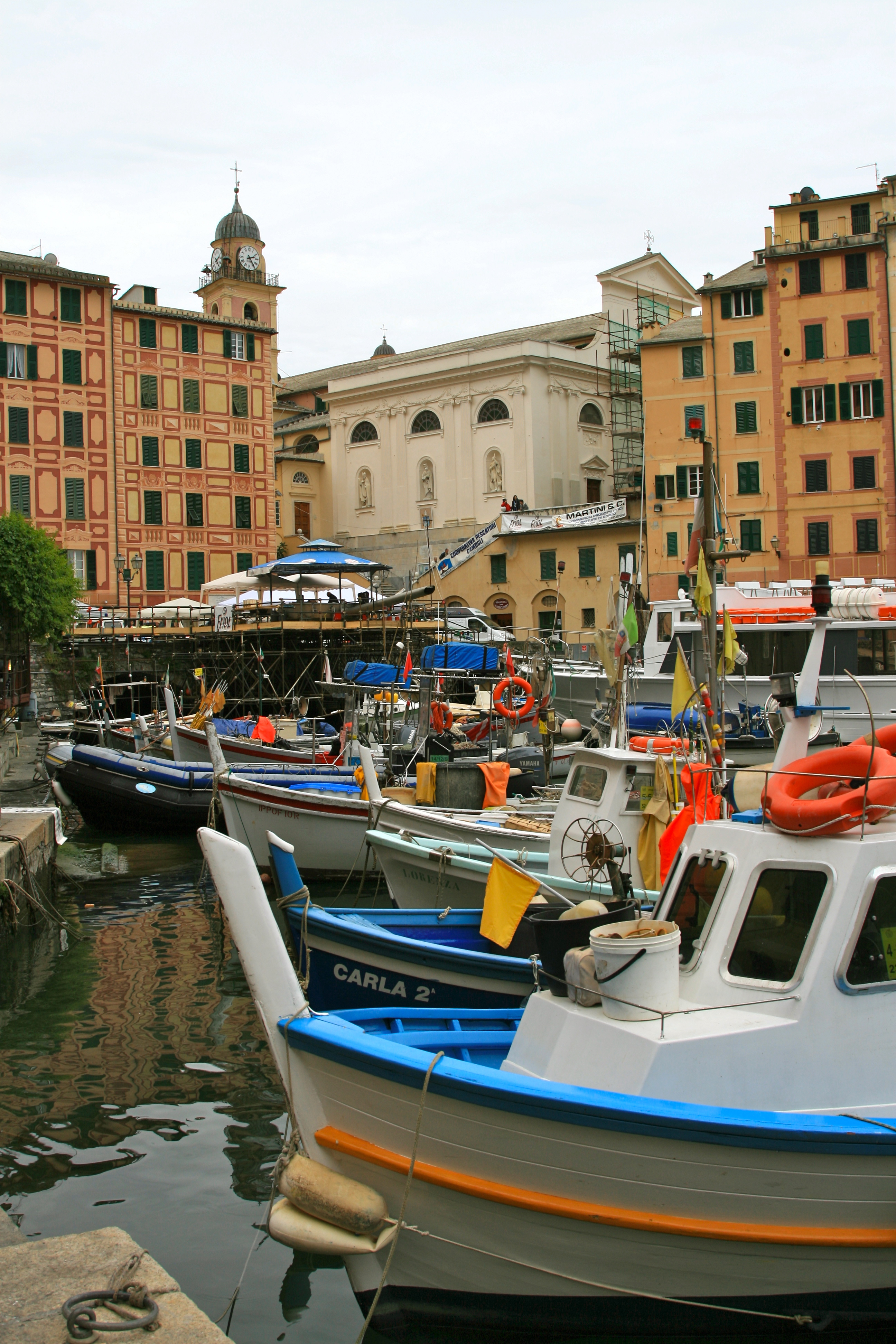
We visited Camogli twice in May and another time in June. Both times the weather was great so people were eating out in the terraces with a splendid view either of the coastline or the tiny but colourful fishing village which bustles with activity. It is said that the fishermen of the village painted the houses in this manner to ensure that they could spot it when they were returning back to the port after their fishing trips. This makes for a great vista as you can see from the photos.

IMG_4649The maritime museum is also worth visiting though not easy to find. For a Maltese, this museum is special because it has paintings of a well known marine artist Nicola Cammillieri, active during the first half of the 19th century who painted beautiful ship portraits both entering the Maltese Grand Harbour as well as in other Mediterranean ports. There are a number of Camilleri’s paintings in the museum, many donated by families from Camogli and most of these are in excellent condition.

Where to eat: Just like in most places in Liguria you will find many Focacceria’s in Camogli. We tried Vento Ariel which overlooks the harbour. The food here was excellent. The menu changes according to the season so you are bound to experience different dishes whenever you go. The children devoured the Ligurian pasta (trofie) with freshly made pesto and I still remember a pate made with cuttlefish and anchovies which are a speciality of the region and the restaurant. The pasta with seafood and fresh fish were also extremely good as was the wine we drank from Azienda Agricola Pino Gino.

Semmu Friti, on the way down to the fishing village is a small takeaway serving, as the name suggests, typical Ligurian deep fried dishes. Here you will find delicious frittelle di baccala, stuffed anchovies and even the traditional ‘farinata’ made with chickpea flour. The deep-fried calamari is also exceptional.

Xodo is another good restaurant and bar serving typical dishes. This is an inexpensive restaurant which is normally packed. On a nice day, you eat outside overlooking the beach. The deep-fried anchovies as starter were excellent as was the fresh seafood black ravioli (using squid ink),

What to do: Just stroll around the seafront, visit the touristic boutique shops and sit and enjoy the sun. Visit the Maritime Museum. Walk on the pebbled beach or take a boat ride to neighbouring Portofino or San Fruttuoso, the latter only reachable by sea. In a recent article in the FT food and drink section Ruth Rogers of the River Cafe mentioned da Laura, on the beach of San Fruttuoso as one of her favourite restaurants in the world. Clearly something to remember for my next visit to Liguria.
 

IMG_4623
The colourful fishing port
IMG_4620
The view from the hill overlooking Camogli

IMG_4655 IMG_4644

The World Cup so far – who will emerge as winner?

The greatest show on earth has reached the last 16 phase and it has been a roller coaster ride for many a team so far. Spain, Italy and England have already packed their bags and left Brazil. For some this has been a surprise, for others the writing had all been on the wall.

Italian football has long been in decline, it was there for all to see with the quality of the Serie A as well as the difficulty faced by the Italians in their friendly just before the World Cup against Luxembourg. Spain’s demise as former World Champions was also stunning though they never recovered from their shocking footballing lesson they received against a strong Netherlands. As for England, while they have what is probably the best domestic league, the quality of the players is still weak for international competitions.

In the above video you will see all the goals scored in the first phase of this World Cup in Brazil. We have had a great start to the competition with some great games and exceptional goals.

The question on any pundits minds is who will emerge as winner now. Eternal South American favourites Brazil and Argentina took off to a somewhat weak start but they have in the meantime recovered. While not being impressive (take Brazil against Croatia for example and Argentina against Iran), they have not disappointed.

Germany are as solid as ever though they were somewhat lucky to take a point in their match against Ghana. The most impressive team to date is probably Colombia.

The odds for World Cup victory are in favour of a South American team. History shows that whenever a world cup is played in America, whether North or South, it is won by a South American team. For sure, the South American continent is guaranteed a semi-finalist given that the winners of Brazil v. Chile and Colombia v Uruguay will face each other in the quarter-final.

The major surprises of the competition such as Costa Rica, Algeria and Greece have shown that modern football is changing. With good organisation, speed and teamwork you can fight for excellent results. Costa Rica or Greece will make it to the quarter-finals and this will be an exceptional result of them. I don’t fancy Algeria’s chances against Germany though they have probably been the greatest surprise of the competition. Their strong performance (albeit they have themselves to blame for the defeat against Belgium) was a prelude to a splendid victory against South Korea and eventually drew against their more quoted opponents Russia.

Belgium, my home for the past eight years, had a  start to the competition which has been far from  exceptional. However, they have taken home three wins and a result which has so far been unsurpassed in their history, i.e. finishing first in their group. Their road from here is tricky and they will need to up their game if they hope to advance in the competition. They have shown they have the players and the solidity to cause surprises. Considered by many as dark horses together with Colombia so far their game has not been impressive. Yet, in football victory when not playing well is considered the hallmark of great teams. if they up their game, and they have the players to do so, then they could still cause a surprise or two.

At this stage of the competition, experience and the will to win enters into play. Luck also plays a part. But as they say from now onwards there are no easy games and to end up as World Cup champions you have to win all the remaining matches.

Given the surprises in the first phase of the competition the question we should be asking is whether we will see a new team lift the cup. In this case it is likely to be Colombia, the Netherlands or who knows Belgium. However, Germany, Argentina and Brazil are all looking solid bets.


Food books (1) – Never trust a skinny chef

You will by now have realised that one of the most inspirational chefs I follow is Massimo Bottura of the Osteria Francescana in Modena. The above video which has been created by book publisher Phaidon as a teaser for the forthcoming book Never Trust a Skinny Italian Chef promises to be one of the most awaited food books of the year.

Here Bottura explains what I like about his style. He is not just a chef but rather a creative inspiration. His lessons are pretty much the same as the ones you would expect from creativity gurus. In this short video you will see why he is considered as one of the best chefs in the world.

The lessons he imparts in these three minutes are valuable in whichever career or phase of your life you are. He believes that with true passion you can transfer emotions. He urges you to get deep into things, to find structure in creativity.

Most of all he asks his chefs to express themselves, feel free and be brave. He says you have to be focused on what is your dream. He says the scary part is that you can realise your dreams.

You cannot clearly fault him on that. In future blog posts, I want to share with you some of the books which have inspired me along the way when it comes to building my passion for food and cooking. As a teaser I would point you to two of my all time favourites which I return time and time again and which have stood the test of time. These are The Silver Spoon for Italian cooking and the Complete Robuchon for French cooking.

How to build your knowledge of wine

IMG_1271
Tuscany is a great place to start if you want to build your wine knowledge

Michael Broadbent for many is the modern patron saint of wine. In 2002, in the Decanter magazine, he listed the ten most important things that he had learned on wine. Two quotes stick to mind.

Drink good wine with every meal. Half a bottle of good wine is more interesting – and better for you – than six bottles of plonk.

Be honest and rely on your own tasting; avoid the influence of others.

Many love to drink a good glass of wine but are intimidated by the subject of wine and most people actually hesitate to go beyond the supermarket shelves.

The subject of wine is incredibly fascinating. It is one of constant discovery, one in which only very few if ever will completely master the subject given the width and breath of wines that can be tasted. Take a region and break it down into different communes, within those communes, find different vineyards, some growing different varietals of grapes. You will find that different producers make different wines a few metres from each other and you will end up asking why is one wine dry and the other less dry? Why does one wine have more alcohol then the other? Why is one wine able to age for many years and the other wine best now? How does a wine evolve in the bottle? The combinations are indeed endless.

My interest in wine grew gradually as my interest in food and cooking developed. Wine and food is a complementary subject and in fact you will find that many magazines dealing with food also have wine sections. But then, you can also find wine magazines which help you to start discovering the world of wines. The US magazine Wine Spectator and the British publication Decanter are both excellent magazines to develop your knowledge of wines. You can also look for the Italian Gambero Rosso or the French La Revue du Vin among others. These are extremely good starting points for discovering wines.

Then there are books like The World Atlas of Wine by Hugh Johnson and Jancis Robinson which is a superb reference book not only teaching you about the growing process of wine but also illustrating with photos, maps and accurate descriptions the wines and specificities of different wines and regions. One of the best books to read on the subject is Hugh Johnson’s A life Uncorked which is a gem of a book which is part biography and full of information on every aspect of wine. This is a book I recommend to all friends because it is beautifully written and touches upon subjects like tasting, cellaring, choosing, understanding, comparing and buying wine as well as wine’s pleasures, lures and mysteries. Read this book with a notebook by your side and write his recommendations. This is the best place to start if you want to learn more about wines.

You can also follow some wine critics on Twitter. Some of the best critics to follow are Jancis Robinson who also writes a weekly column in the Financial Times, James Suckling formerly of Wine Spectator and now having his own website. I also particularly like the insights of Tim Atkin and Robert Joseph among others. My favourite wine blogger is Alder Yallow who writes a wine blog – Vinography.

There is a more direct approach to wine which is to head to a wine region and let yourself become immersed in the culture of wine of that wine region. Whichever the region, you are bound to discover passionate people who will guide you to what the region has to offer in terms of wine and cuisine. They will indicate their favourite wineries or wine stores. The latter are also a great source of information. Go with an open mind and allow the wine merchant to take you on a voyage of discovery. If you eliminate your prejudices, you are bound to be pleasantly surprised.

One thing which I have discovered is that whenever there are vineyards, the landscape is bound to be beautiful if not spectacular. This is the case wherever you go.

Once you start to get more and more knowledgeable you are bound to discover that you want to learn more and more. What is most important is to avoid plonk and always choose to try wines from winemakers which have a story to tell. When you do that, you are bound to never be disappointed. As they like to say, life is too short to drink bad wine.


Beat your fear – how I overcame my phobia of cheese

IMG_6135Phobias are irrational and unexplainable. Cheese until a few years ago was my achilles heel. Few people could understand how someone who could be so obsessed with food and wine had a ‘fear of cheese’. This was not an allergy but rather real fear.

I recall a day when I was still at school and a friend had placed a piece of cheese in my school bag as a joke. I never used that bag again. I remember protesting with my father to refrain from using the same knife he had used to cut a piece of cheese to cut bread or spread butter. I even would tell him to wash his hands before handling anything else.

Such was my fear. Now, with the benefit of hindsight a fear of cheese is not only irrational, it is also ridiculous. This was not an allergy. That would be perfectly understandable. Can you imagine never eating a pizza with mozzarella. Hard to believe but true.

So you can just start to imagine what a big deal it was to actually try cheese for the first time. I overcame this phobia thanks to my wife who  talked me into trying what in Malta we call fresh goat’s cheeselet, similar in taste to ricotta which was the only ‘cheese’ I liked.

It took a few weeks to convince myself that I would try this cheese which has a similar texture and taste to ricotta but which was out of bounds because of this fixation.

I still remember the day in Gozo, the second island in Malta, when served with this mild goats’ cheese. The anticipation was tremendous. But as soon as I tasted it for the first time, my reaction was a rather incredulous one. I remember smiling and then wondering ‘what was all the fuss about?’.

The next hurdle to overcome was Mozzarella di Bufala and again the reaction was pretty similar.  As soon as I tried it, I again remember that the reaction was a similar one. Then it was an overdose of pizza with mozzarella to compensate for what I had missed in the past.

The conversion to Parmigiano Reggiano was more painful. I recall going to Fulvio Pierangelini’s Gambero Rosso, at the time considered as the best Italian chef who had an exceptional restaurant in a small Tuscan town near Bolgheri called San Vincenzo. I promised myself that I would try whatever was served to me in this restaurant.

The tasting menu looked safe given it was mainly fish-based but I opted to add suckling pig as an additional dish on top of the tasting menu. All was fine until the kitchen sent an amuse bouche which was a small ‘cannolo’ stuffed with mince of suckling pig. It was sprinkled with Parmigiano Reggiano. I started sweating, my face turned red and I panicked. The table next to us realised something was wrong because they were looking at us constantly. There was clearly no turning back. Leaving the dish there would have led to lots of questions and probably a visit from the chef to our table to ask whether there was a problem.

And then, I plucked up the courage and tried it for the first time. Those were probably the longest moments of my life. But again my reaction was one of wonder. What was all the fuss about? Not only was the taste mild, it actually boosted the flavour of the dish.

So for the time being, only blue cheese is off limits though I must say that this is again more psychological than rational. Actually, I have tried Roquefort once and again found it rather mild except for the smell which takes some getting used to.

Proof, if any was needed, that I overcame the phobia, came a few weeks ago at Massimo Bottura’s Osteria Francescana. There served with his signature dish, the five ages of Parmesan, I actually thought that it was one of the best dishes I have ever tastes. Such are the wonders of life.

The moral of the story is to fight your fears and try to beat the irrational.

Here are my tips

1. Talk yourself into fighting your fear.

2. Believe that you can beat your fear.

3. Read about what you are afraid of. In my case it was reading about food and wine including articles about different cheeses, pairing with wines etc. If you are  afraid of flying, read travel books, think about places you would like to visit or about planes. You get the gist.

4. Start gradually and increase the dose step by step.

5. Speak about your conquest. Be enthusiastic and tell anyone who wants to listen.

6. Ideally find someone with whom you can share your steps.

7. Good luck – you can beat your fear.

Street food dishes in London – FT.com

Street food dishes in London – FT.com.

If you are heading to London, here is a list of five street food dishes worth trying.