Does anyone really care about tourist traps?

IMG_6042One of the most famous streets in Brussels among tourists or people on business trips is the Rue de Bouchers. It can be found just a few metres away from the Grand Place.

Walking from the street at the Grand Place area last week on the evening when Belgium was playing against South Korea and locals were obviously nowhere near any restaurant without a television set, I could not help but wonder what makes people visit such restaurants around the world.

What are they looking for? Why would locals consider such places a tourist trap but so many have no qualms in sitting down and eating there. What is so attractive about waiters greeting you in all languages as they try to guess your nationality to try and get you in?

In the case of Brussels, are the mussels and fries served in such places so different in quality to restaurants which cater mainly for locals? Do the tourists who sit down to eat in such places care about the difference? Are they more interested in the experience of eating al fresco as the day gets longer as long as they sit and enjoy a glass of beer or wine? Is the location more important than quality?

What triggers such behaviour? Is it the wisdom of the crowds?

This is a common phenomenon not only in the city I know best. Tourist traps can be found pretty much in every city. The more tourists a city attracts the more you are likely to find such places. Take cities like Paris and London. They are among the top most culinary destinations but get it wrong and you are likely to end up being extremely disappointed.

Have you ever noticed how many times bars, restaurants and cafes in the best locations or with great views have the lousiest service? Is there a correlation between location and quality? Do places which cannot attract customers on the basis of location go the extra mile to please their customers for this reason? Are they more passionate about the food they serve, the provenance of their produce?

But for the many who frequent such places, does it really matter?


Belgium day trips 2: Gaasbeek and the Waterhof farm shop

IMG_1262
The Waterhof farm

Amid the gently rolling hills of the Pajottenland just outside Brussels lies the beautiful village of Gaasbeek. This is one of our favourite spots just outside the Belgian capital and for a number of reasons.

The first reason is a splendid medieval castle, the Gaasbeek castle which has evolved from a strategic stronghold into a spacious country house. One of its most famous owners was the Count of Egmond.

While on the other side of Brussels you will find the Chateau de la Hulpe, Gaasbeek, to the West of Brussels makes for a great alternative. The castle lies within an extensive park which was already laid out in the 17th century. It has impressive avenues and narrow winding paths as well as beautiful beech trees. From the park you can see the beautiful countryside with numerous cows grazing in the fields. It is indeed impressive to think that this is just a few kilometres outside the city.

You can visit the castle and the museum garden. Moreover, the lands also house the Graaf van Egmond brasserie. Just opposite the castle you can find a brasserie with a great outdoor playground for children which includes a bouncy castle. This is a great place for children to play.

IMG_9163But the hidden secret of Gaasbeek and probably the best reason to return from time to time is a farm shop just outside the village. The farm is called Waterhof and it is one of those places which are so charming that you wish to discover more of them in the surrounding countryside.

Firstly the farm makes its own milk thanks to its more than 60 cows. Given that the artisanal method of producing their products is time consuming, the Waterhof farm have invested in a robot which milks the cows automatically and you can also see this in action when the farm or shop is open. The farm, which is more than 500 years old (with the oldest standing building  dating from 1813) makes superb ice-creams using their own produce. You can also buy butter, cheese, yogurt (excellent), puddings, chocolate mousse and butter milk (lait battu). You can also buy pastries, juices as well as a wide range of potatoes and seasonal fruits and vegetables.

IMG_9170
One of their speciality ice-creams served at the farm, the tiramisu

The highlight is a courtyard where you can try the superb range of ice-creams served. When its cold, there is also space inside. This is really a superb place to take children. Not only do you treat them to excellent ice-cream but they can visit the barns where the cows go to rest after grazing the fields in the hills around the farm. There is also a small barn with calves open for visitors.

Verdict: This place is so good I hesitated before writing about it lest this becomes too commercial.  If you are going on a hot day, make sure to take a cooler bag to transport the ice-cream and other produce. You will not be able to resist the temptation of buying a few litres for home. Drop me a line if you try it and if you know of other similar places in Belgium.


Santorini – a wine region worth discovering

IMG_8675
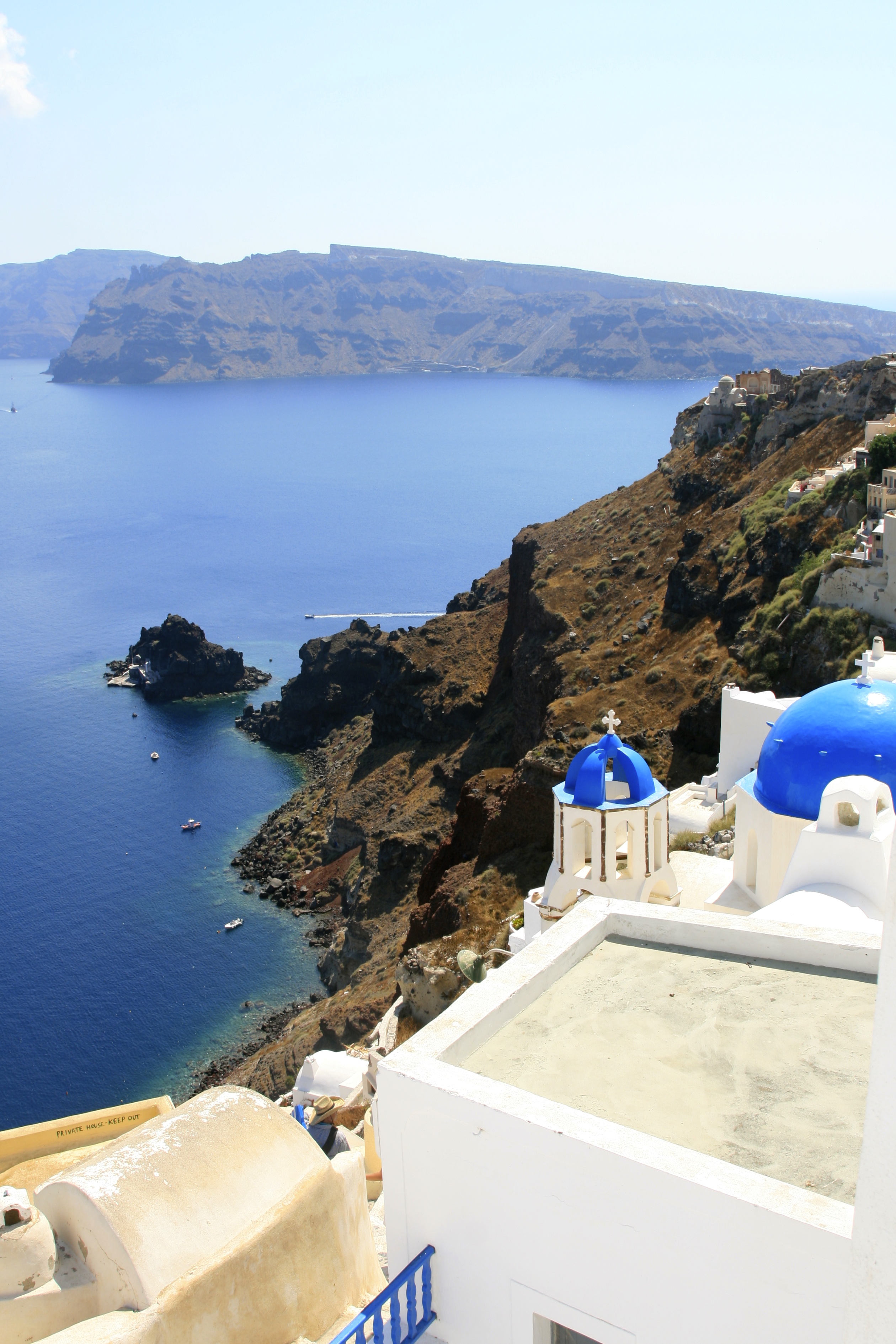
Santorini’s views can be breathtaking. Its wines are however worth discovering

It might sound like a cliche but Santorini is all that you can imagine about a Mediterranean island if not more. This volcanic island offers crisp blue seas, breathtaking views, glorious sunsets, excellent produce (particularly tomatoes and aubergines) and incredible wines.

The latter may come as a surprise for people not necessarily in the know. Greek wines can be surprising in their quality. But in terms of island wines, the ones which come from this beautiful island in Southern Aegean are exceptional.

If you have never tried the white wine Assyrtiko, which has a potent dryness and minerality with strong hints of lemon, then you are clearly missing something really special. Just like with Riesling, the first time I tried this grape variety, I was immediately hooked.

The volcanic soil of Santorini is great for grape growing and while many might consider the conditions to be too harsh for wine growing, both the land and the climate make for exceptional wines with great ageing potential.

IMG_8757
The Domaine Sigalas vineyards

The wine makers to look out for in Santorini, and those which are also available outside the island are Domaine Sigalas, Hatzidakis and Gaia – not to be mistaken for the wines of Italian wine giant Angelo Gaja.

Another white grape variety is Athiri which is also an indigenous, white variety. Athiri is an aromatic variety, of lower acidity than Assyrtiko and lower potential alcohol. This is also blended with Assyrtiko making a very interesting combination.

Among the reds is the lesser known though equally excellent Mavrotragano, a red variety indigenous to the island.  This grape came close to extinction but is again being grown by a number of wineries on the island. I can confirm that this wine has exceptional ageing potential. I have tasted a few 2004 over the years and still have a few in my cellar.

When in Santorini we visited the winery of Domaine Sigalas close to Oia. The wine tasting was exceptional in that you tasted the wines pretty much in the middle of the vineyards in a perfect setting. Despite being a small island, Sigalas produces around 300,000 bottles of wine annually and their wines are exported to many countries including Germany, France, Belgium, Austria, Holland, England, Cyprus, Switzerland, Hong-Kong, Shanghai, Sweden, Singapore, Australia, Brazil, USA and Canada.

We were told that the vines in Santorini are extremely old and have resisted to phylloxera (which is attributed to the fact that that the volcanic soil is well drained). This means that the vines did not need to be replaced during the epidemic of the late 19th century. What is interesting about the Santorini wines is that the vines are planted far apart to get as much exposure to dew as possible and they are often made in the shape of low-spiralling baskets, with the grapes hanging inside to protect them from the island wind.

My recommendation is to try the wines from Santorini if you come across them whether in your favourite wine store or a restaurant or wine bar. You will surely not to be disappointed. The white Assyrtiko might well be among the best wines you have tried in many years.


How to build your knowledge of wine

IMG_1271
Tuscany is a great place to start if you want to build your wine knowledge

Michael Broadbent for many is the modern patron saint of wine. In 2002, in the Decanter magazine, he listed the ten most important things that he had learned on wine. Two quotes stick to mind.

Drink good wine with every meal. Half a bottle of good wine is more interesting – and better for you – than six bottles of plonk.

Be honest and rely on your own tasting; avoid the influence of others.

Many love to drink a good glass of wine but are intimidated by the subject of wine and most people actually hesitate to go beyond the supermarket shelves.

The subject of wine is incredibly fascinating. It is one of constant discovery, one in which only very few if ever will completely master the subject given the width and breath of wines that can be tasted. Take a region and break it down into different communes, within those communes, find different vineyards, some growing different varietals of grapes. You will find that different producers make different wines a few metres from each other and you will end up asking why is one wine dry and the other less dry? Why does one wine have more alcohol then the other? Why is one wine able to age for many years and the other wine best now? How does a wine evolve in the bottle? The combinations are indeed endless.

My interest in wine grew gradually as my interest in food and cooking developed. Wine and food is a complementary subject and in fact you will find that many magazines dealing with food also have wine sections. But then, you can also find wine magazines which help you to start discovering the world of wines. The US magazine Wine Spectator and the British publication Decanter are both excellent magazines to develop your knowledge of wines. You can also look for the Italian Gambero Rosso or the French La Revue du Vin among others. These are extremely good starting points for discovering wines.

Then there are books like The World Atlas of Wine by Hugh Johnson and Jancis Robinson which is a superb reference book not only teaching you about the growing process of wine but also illustrating with photos, maps and accurate descriptions the wines and specificities of different wines and regions. One of the best books to read on the subject is Hugh Johnson’s A life Uncorked which is a gem of a book which is part biography and full of information on every aspect of wine. This is a book I recommend to all friends because it is beautifully written and touches upon subjects like tasting, cellaring, choosing, understanding, comparing and buying wine as well as wine’s pleasures, lures and mysteries. Read this book with a notebook by your side and write his recommendations. This is the best place to start if you want to learn more about wines.

You can also follow some wine critics on Twitter. Some of the best critics to follow are Jancis Robinson who also writes a weekly column in the Financial Times, James Suckling formerly of Wine Spectator and now having his own website. I also particularly like the insights of Tim Atkin and Robert Joseph among others. My favourite wine blogger is Alder Yallow who writes a wine blog – Vinography.

There is a more direct approach to wine which is to head to a wine region and let yourself become immersed in the culture of wine of that wine region. Whichever the region, you are bound to discover passionate people who will guide you to what the region has to offer in terms of wine and cuisine. They will indicate their favourite wineries or wine stores. The latter are also a great source of information. Go with an open mind and allow the wine merchant to take you on a voyage of discovery. If you eliminate your prejudices, you are bound to be pleasantly surprised.

One thing which I have discovered is that whenever there are vineyards, the landscape is bound to be beautiful if not spectacular. This is the case wherever you go.

Once you start to get more and more knowledgeable you are bound to discover that you want to learn more and more. What is most important is to avoid plonk and always choose to try wines from winemakers which have a story to tell. When you do that, you are bound to never be disappointed. As they like to say, life is too short to drink bad wine.


Monschau – a beautiful German town on the border with Belgium


20140622-213208-77528073.jpg
Monschau, the main square

Summer has started and we have had our fair share of barbecues already. Crisis point was reached a few days ago when we ran out of our special mustards with tarragon and Riesling which we had purchased from our annual visit to Monschau, Germany during the Christmas season.

We had never visited the idyllic town during spring or summer for some reason and have always associated the town with winter especially given how spectacular it looks when it snows. So, we did what some might consider a crazy day trip, which is heading to Monschau to stock up on mustard lest our barbecues suffer from the lack of magic ingredients.

Now you might probably have realised that when it comes to food, I do not cut corners and am bound to take a detour if I can procure great ingredients. But, given the fact that until a few years ago, I was not really keen on mustard, you will understand that the Monschau mustards are indeed special. All it takes to convert to the joys of mustard are a trip to Dijon or Monschau, away from the commercial stuff you find in supermarkets.

But back to Monschau. Monschau is a beautiful town located in the hills of the North Eifel within the Hohes Venn – Eifel Nature Park in the narrow valley of the Rur river.

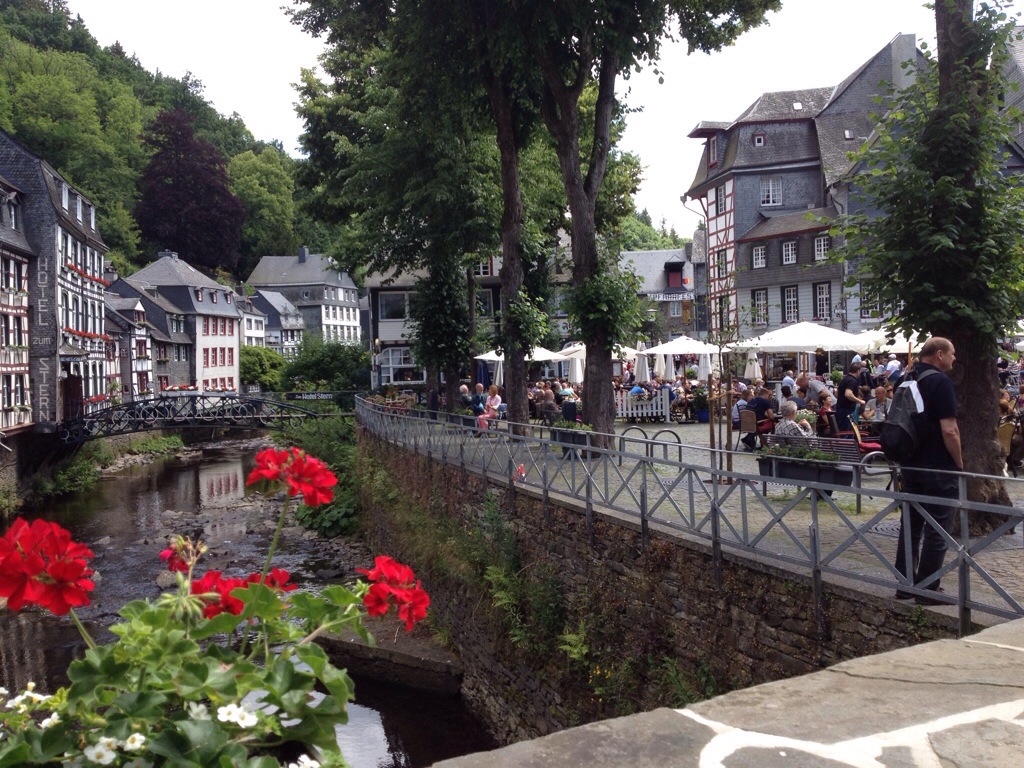
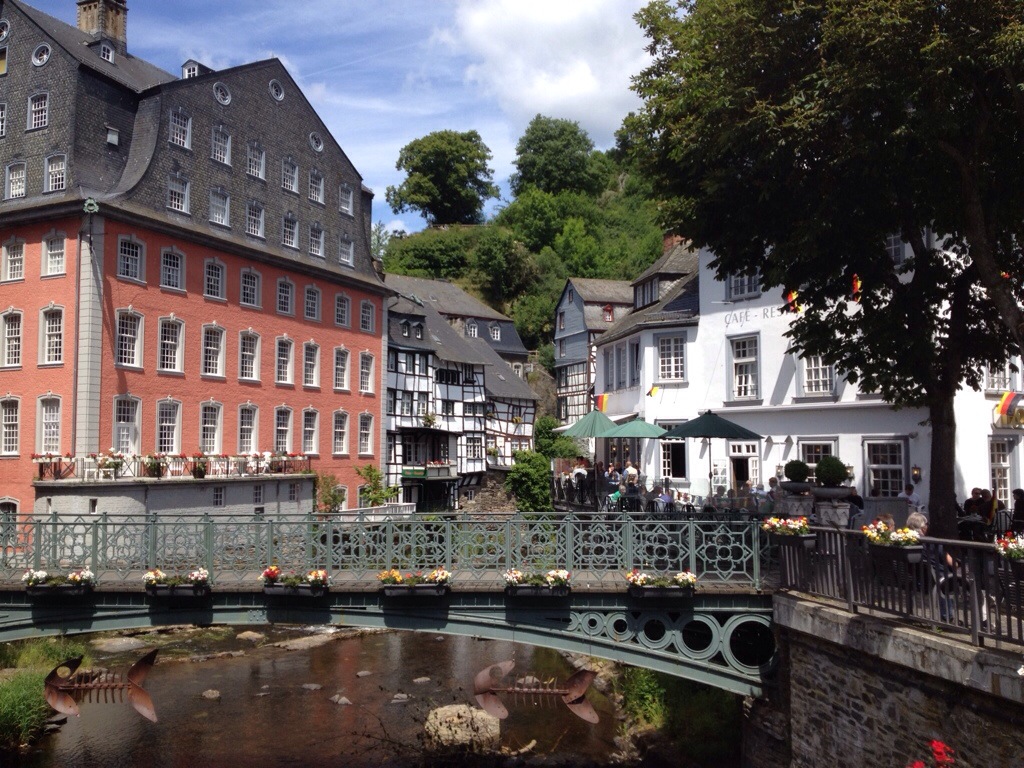
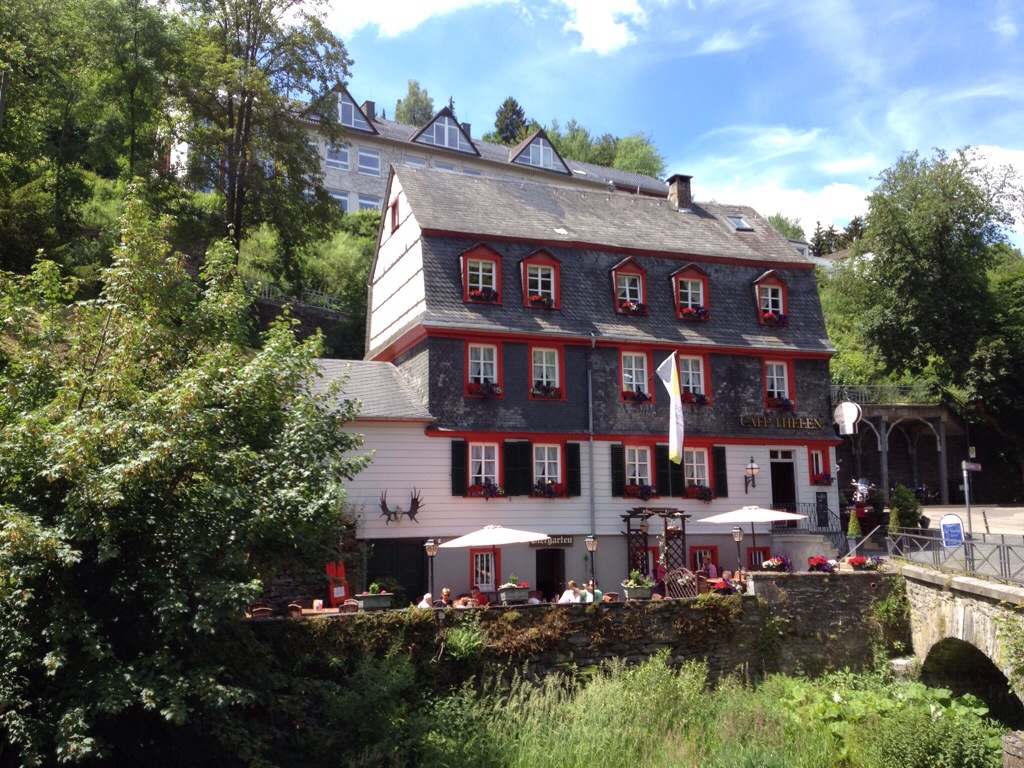
The historic town centre has many preserved half-timbered houses and beautiful narrow streets which look as if they have remained unchanged for time so long. The setting is fantastic given the town is literally in a valley and is surrounded by beautiful hills.

The town is extremely picturesque. In summer, all the restaurants and hotels have tables outside making dining al fresco a joy given the stunning vistas and fresh air.

20140622-213208-77528539.jpg
The Monschau city hall

A few shops are worth visiting including some cafes which serve typical German cakes. A bakery just off the main square has typical German breads and sweets from the region while the special mustard shop sells a lot of regional produce including alcohol and pork products.

Mustard here varies from the classic, which is spectacular used in a salad dressing, to tarragon, garlic, chili, green pepper, old German, Horseradish, English curry, caraway seeds, lemon, orange, tomato, currant, honey with poppy seeds, fig, Riesling, wild herbs, ginger and pineapple as well as the new beer mustard which also promises to lift our coming barbecues to something special.

20140622-213207-77527588.jpg
One of the many restaurants in the town

The drive there from Belgium is also spectacular. You pass through Eupen, a  very pretty Belgian town from the German speaking part of Belgium and then through the the Hautes Fagnes, which is the highest point in Belgium at an altitude of 694 metres.

Verdict: A great place to visit both in summer and winter. If you go in winter, try to visit when it has snowed because the charm of the place is incredible. In summer the town also has great charm.


Caffe al Dente – a wine lover’s den

5
Caffe al Dente has an impressive selection of Italian wines – Photo taken from Caffe al Dente’s website

Ask any Italian, and there are many in Belgium, what their favourite Italian restaurant would be and you are likely to get a very different answer from each and every one of them.

Italians take their food very seriously but probably few as seriously as Federico of Caffe al Dente. A Roman who has settled in Brussels, he is obsessed with a simple rule “Il Pesce non si serve con il formaggio”, i.e. it is a sin to serve cheese with fish.

Now there are some who argue that the client is always right. At Caffe al Dente this is not necessarily the case. If you go there, you will notice that they take this rule extremely seriously. You will find an asterisk on the blackboard with the day’s menu telling you that the pasta dish with fish or shellfish will not be served with cheese on top, and there will be other small blackboards hanging around in the restaurant telling you that you should not put cheese on your spaghetti alle vongole (with clams).

Of course, there is no question that this would be akin to a mortal sin. But while the French or the British are known to use cheese with certain fish dishes, the rule is not as rigid as it sounds. There are some regions which are starting to experiment with fish based dishes and cheese. If you look at Sicilian cuisine, you are bound to find the occasional dish such as the polpette sarde (sardine balls) having pecorino inside. I have also come across a 2 Michelin star chef Gennaro Esposito of Torre del Saracino  who stuffs calamari with smoked cheese.

But back to Caffe al Dente. This is a really great place. Firstly it has an Italian wine list which is incredible in its depth. There are wines from pretty much all regions of Italy and most of the best wine houses are covered. The prices, compared to other Brussels restaurants are also very reasonable given that the wine list shows the price for buying the wines from the enoteca next door as well as those charged in the restaurant.

The menu is extremely simple so you might go there once and be disappointed because of the choice on offer. But the mantra is rather simple. They use what is available and what is in season. So you are unlikely to eat the same thing if you go on separate occasions. They have a choice of two or three antipasti, two or three pasta dishes and two or three main courses. The same goes for desserts.

I have eaten there on a few occasions and the food and service have always been good albeit sometimes slightly slow. But then, that allows you time to savour the atmosphere, drink wine in good company and to chat with Federico who is a very interesting character.

The time we asked him about the cheese philosophy he told us that a client had once walked out after insisting that he wanted cheese with his Spaghetti Marinara. He told us how, at one point his client asked him whether he was going to bring cheese or else he might as well give him the bill. He refused to take cheese to the table and sent the bill instead. The customer walked away angrily but Federico told us that he returned a few days later with an apology and a gift for him.

I am here to offer an authentic service he had told us. Most of the people who come here come for an authentic Italian experience. How can I serve cheese with fish if that is not how it is done in Italy? You must respect the place you are in but you must also understand our philosophy. You cannot really fault him with that.

Verdict: This is one of my favourite Italian restaurants in Brussels. The food is excellent, the atmosphere nice, the wine list for Italian wines is probably one of the best I have seen outside Italy. It is like going to an Italian enoteca. The good thing is that it is in Brussels. Booking recommended because it can fill up very easily.

Caffe al dente

Rue du Doyenné 85, 87, 1180 Bruxelles