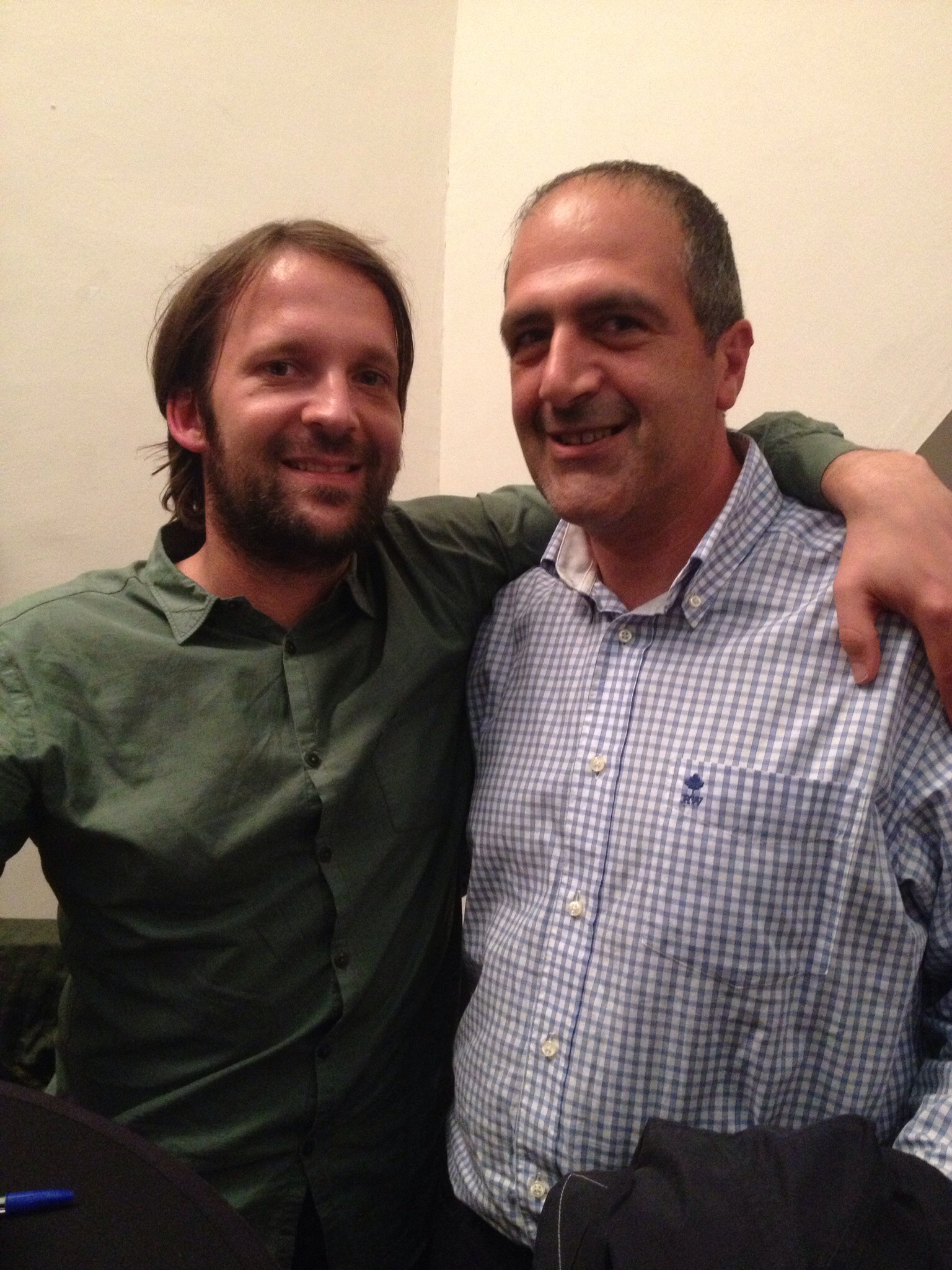
36-year-old Rene Redzepi is on top of the culinary world again after regaining top spot for his restaurant Noma in the World’s 50 best restaurants. Yesterday he was in Gent to present his new book A Work in Progress which is part journal, part recipe book and a flick book.
He gave an inspirational talk while reading parts of his journal which recounts the day-to-day life at Noma.
I went thanks to our dear friends from Gent, Anna and Marteen of Villa Bardon. The stress to get there was probably worse than manning a station on a busy evening in a restaurant. The traffic to get out of Brussels was horrendous.
Redzepi is one of few chefs who have managed to take food to a level of creativity that can inspire people. These chefs, like Adria, Bottura, Blumenthal and the Roca brothers have broken away from traditions while at the same time going back to the roots. They break taboos or preconceived ideas and perceptions.
As he himself says, it would have been unimaginable 10 or 20 years ago for a restaurant like his to be considered for Michelin stars.
At 36-years-old, Redzepi says he is actually one of the oldest people working in the restaurant.
Having read quite a few books on creativity over the past few months including for example Creativity Inc by Ed Catmull, The Myths of Creativity by David Burkus, and Todd Henry’s Die Empty, Unleash your best work every day (all of which are worth reading) it was interesting to see that Redzepi follows pretty much the same concepts in his kitchen. Creativity does not come by chance but through hard work, collaboration, team-work and ambition.
The main takeaway from his talk yesterday was that there has to be collaboration is essential in a team but most of all you must create an environment where people are confident that they can experiment without being ridiculed or laughed at. The restaurant has a very interesting tradition. On a Saturday evening, after an 85-hour work week, one chef has to present a dish to the rest of the team. It is here that innovation takes place. During the talk he showed a video of chefs being presented with a pig’s ear and another of a Kale (cabbage) ice-cream which believe it or not, he said tasted extremely good. There have been a few bad experiences he says but in general, the team has been stunned on many more occasions. “Can you imagine kale being served as an ice-cream. Until a few years ago this vegetable was used to feed horses. Then we discovered its nutritional value but it still is a cabbage. Suddenly it becomes a dessert, and the dish actually works. You need to have courage to think of and then present such a dish”
He noted how a dish can go through much iteration as it is improved once step at a time until the final product emerges from the test kitchen.
The story of how they introduced ants in Noma as part of a dish was also intriguing. He recounts how they experimented with ants and actually served it for the first time in the restaurant hidden with crème fraiche. He explains in detail the reaction of the first clients when they were told about the ants they were being served in the dish and their faces suddenly changing colours. Nowadays, he uses ants, which taste like lemon-grass as a condiment but at the time they served them first at Noma, he ended up being talked about in the press and even made it to the Danish Parliament. He said an American chef who was a friend of his phoned to ask whether he was crazy to serve ants in his restaurant. “I tried to find consolation by phoning the chef who introduced me to ants, Alex Atala from Brazil. When I told him the story, there was silence on the phone for ten seconds and then he asked, What, you served ants?” The bottom line – forget preconceptions.
During question time, Redzepi said he thinks that in future we will have to learn to cook things which people used to eat in the past but which have now been forgotten or else explore new ground. We need to get back in touch with the earth, he thinks. He is of the view, and this seems to be shared by others, that in the coming years, people will probably be eating more insects.
With the cost of beef rising and the impact cows have on the environment, it is likely that meat will be eaten only occasionally. The challenge, he says is to make insects appealing. What would you choose between a bowl of crickets or a nicely seared steak with parsley butter and fries? The answer for the time being is obvious.
He says that meat is now being grown in labs, he knows someone who tasted it and doesn’t mince his words. “It tasted like shit. But it is protein and it is being created in a laboratory.”
He thinks that the provenance of food will become more and more important in future. Rene Redzepi is chef of probably one of the world’s most famous restaurants. But he is also much more than that. He is passionate, hard-working, ambitious and in a very enjoyable hour and a half, he provided important lessons not only related to food but also on creativity, hard work and team-work.
I look forward to visit Noma soon though I am not so sure about what my reaction will be if served ants. Maybe I should also forget my preconceptions.

 Ivan Brincat